

Placing Numbers on a Number Line - Tablet Version
Related Worksheets
23/11/17 - new version added. This version is tablet friendly and can be played directly on any device.
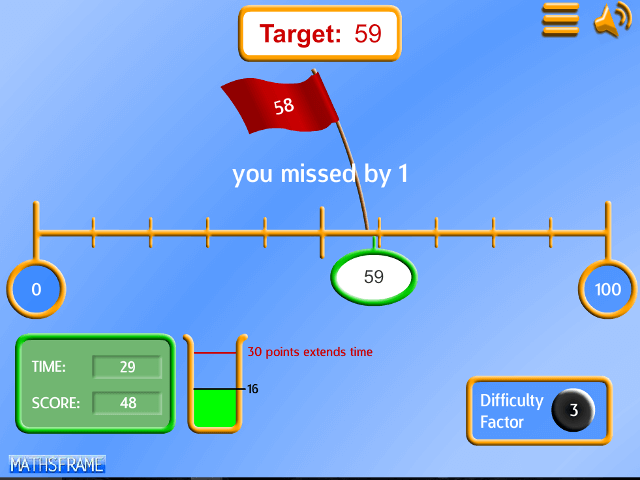
Drag the flag to the correct position on a number line. Lots of choice over level, including whole numbers, negative number and decimals. Can be used to teach place value, approximation skills, and reading varying scales.
Choose one type of number line or for more of a challenge you can select several. Work quickly to get more time, build your score and climb up the leaderboard.
For more resources involving partitioning and place value click here.

Game Objectives
New Maths Curriculum:
Year 2: Recognise the place value of each digit in a two-digit number (tens, ones)
Year 2: Compare and order numbers from 0 up to 100; use <, > and = signs
Year 3: Compare and order numbers up to 1000
Year 4: Order and compare numbers beyond 1000
Year 6: Use negative numbers in context, and calculate intervals across zero
KS2 Primary Framework:
Year 3:
Order whole numbers to at least 1000 and position them on a number line (Block A)
Year 4:
Compare the impact of representations where scales have intervals of differing step size (Block C)
Year 5
Interpret a reading that lies between two unnumbered divisions on a scale (Block C and Block D)
Year 6: